The Capitalyst: You trained as an engineer at BITS Pilani, studied development economics at Princeton, spent years at Morgan Stanley in New York and Hong Kong, co-founded Kama Ayurveda when you returned to India in 2000, and only then encountered a master artisan named Ramesh and began working with brass. It is an unusually indirect path into design. What did that detour give you that a formally trained designer or artisan might never have developed?
Vikram Goyal: I don’t experience that journey as a detour so much as a layering of disciplines. Engineering trained me to think structurally, to understand systems and constraints. Development economics sharpened my awareness of value, how it is created, distributed, and often misunderstood, particularly in the context of craft. My years at Morgan Stanley instilled a certain rigor and discipline, an ability to navigate complexity and risk.
Co-founding Kama Ayurveda was, in many ways, my first real engagement with Indian traditions not from a distance, but from within. It brought me into close contact with systems of knowledge that were deeply rooted in the country’s cultural and material history, yet needed to be rearticulated for a contemporary context. That experience shaped my sensitivity to authenticity, to sourcing, and to the importance of preserving integrity while building something new.
So when I eventually encountered Ramesh and began working with brass, I was not approaching it with the singular lens of a designer or artisan. I came to it with curiosity, but also with a willingness to question inherited assumptions about scale, about material, about what craft could be. That distance, I think, allowed me to see possibilities that may not have been immediately visible within a more linear training. It also gave me a deep respect for the ecosystem around craft, not just the object, but the people, histories, and economies that sustain it.
The Capitalyst: Your studio works with around a hundred artisans, many carrying intergenerational knowledge of repoussé, pietra dura and hollowed joinery, techniques cultivated in India as far back as the 3rd and 4th century BC. You have pushed repoussé to architectural scales of 20 to 30 feet, beyond any historical precedent. When you ask an artisan to attempt something that has never existed within their own lineage of craft, what does that negotiation look like, and how do you build the trust required to make that leap?
Vikram Goyal: The process is never directive, it is always dialogic. When you are working with artisans who carry generations of embodied knowledge, you are not asking them to abandon that lineage, but to extend it.
Often, it begins with a shared act of looking at references, at drawings, at prototypes. There is a moment of hesitation, sometimes even resistance, because what is being proposed sits outside the comfort of what has been done before. But that hesitation is important, it signals care.
Trust is built over time, through consistency and mutual respect. It also comes from being present in the process, working alongside, failing together, iterating. When we pushed repoussé to architectural scales, it was a series of incremental experiments. Each success, however small, becomes a bridge to the next possibility. Over time, what was once unimaginable becomes part of a new shared vocabulary.
The Capitalyst: PAD London 2023 marked not only your first international solo exhibition but also the first solo presentation at the fair by a contemporary designer from India, curated by Nilufar. Around the same time, you became the first Indian designer represented by the gallery in Milan. Experiencing those two “firsts” in close succession, how did that position feel in practice, and what kind of responsibility, if any, does it impose on you?
Vikram Goyal: Those moments were significant, of course, but I was very conscious of not being defined by the idea of a “first.” In practice, what mattered more was the opportunity to present a body of work in a context where it could be engaged with seriously, without being reduced to a token of geography.
That said, there is an implicit responsibility. When you are among the first from a particular context to occupy a space, you are inevitably read as representative. I have tried to approach that not as a burden, but as an opening, to expand the perception of what contemporary Indian design can be, beyond the expected narratives of ornament or heritage. It is about demonstrating that craft can operate at the highest levels of conceptual and material sophistication.
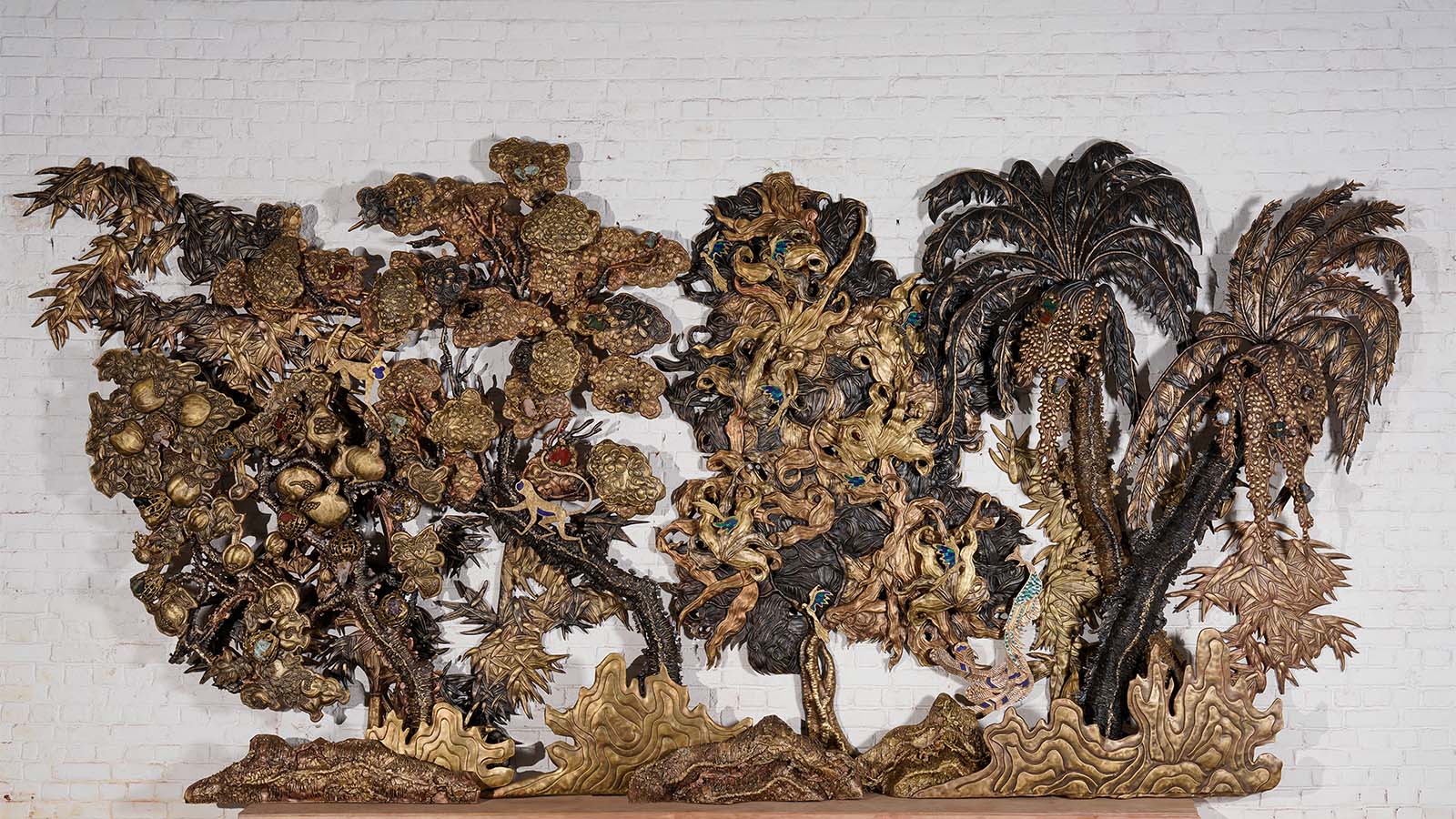
The Capitalyst: At Design Miami 2024 with The Future Perfect, your central work, Garden of Life, was a nine-foot-tall, nineteen-foot-wide mural drawing on Silk Road histories, combining brass repoussé, semi-precious stone inlays, pietra dura and casting. That same year, your collaboration with de Gournay translated three of your repoussé works into gilded, hand-painted wallpaper. What fundamentally changes when a work moves from sculptural brass into a flat surface? Where does the meaning of the work actually reside, in material, in technique, or in image?
Vikram Goyal: When a work moves from a sculptural object into a flat surface, something fundamental does shift. In brass, the material carries memory of touch, of force, and of time. The act of repoussé leaves behind a trace of the hand, the surface is not just seen, it is almost read.
On a flat surface like wallpaper, that physical depth is translated into illusion. What remains constant is the image, but the ontology of the work changes. It becomes more about perception than presence.
For me, the meaning does not reside exclusively in any one dimension be it material, technique, or image, but in the tension between them. The translation into wallpaper with de Gournay was interesting precisely because it tested how much of that meaning could survive when the tactile dimension was removed. It revealed that while materiality is central, the narrative and compositional logic of the work can also carry a certain autonomy.
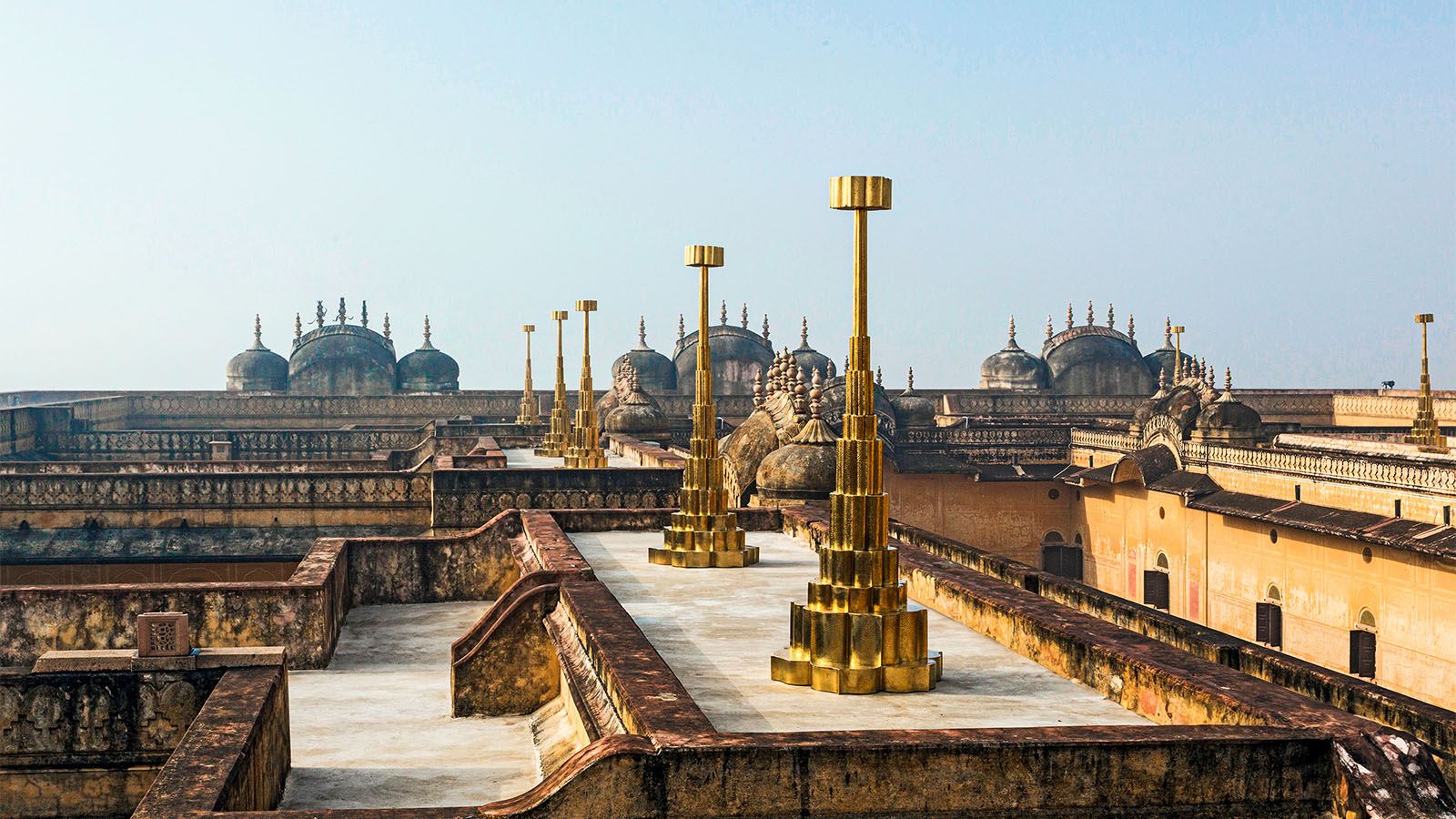
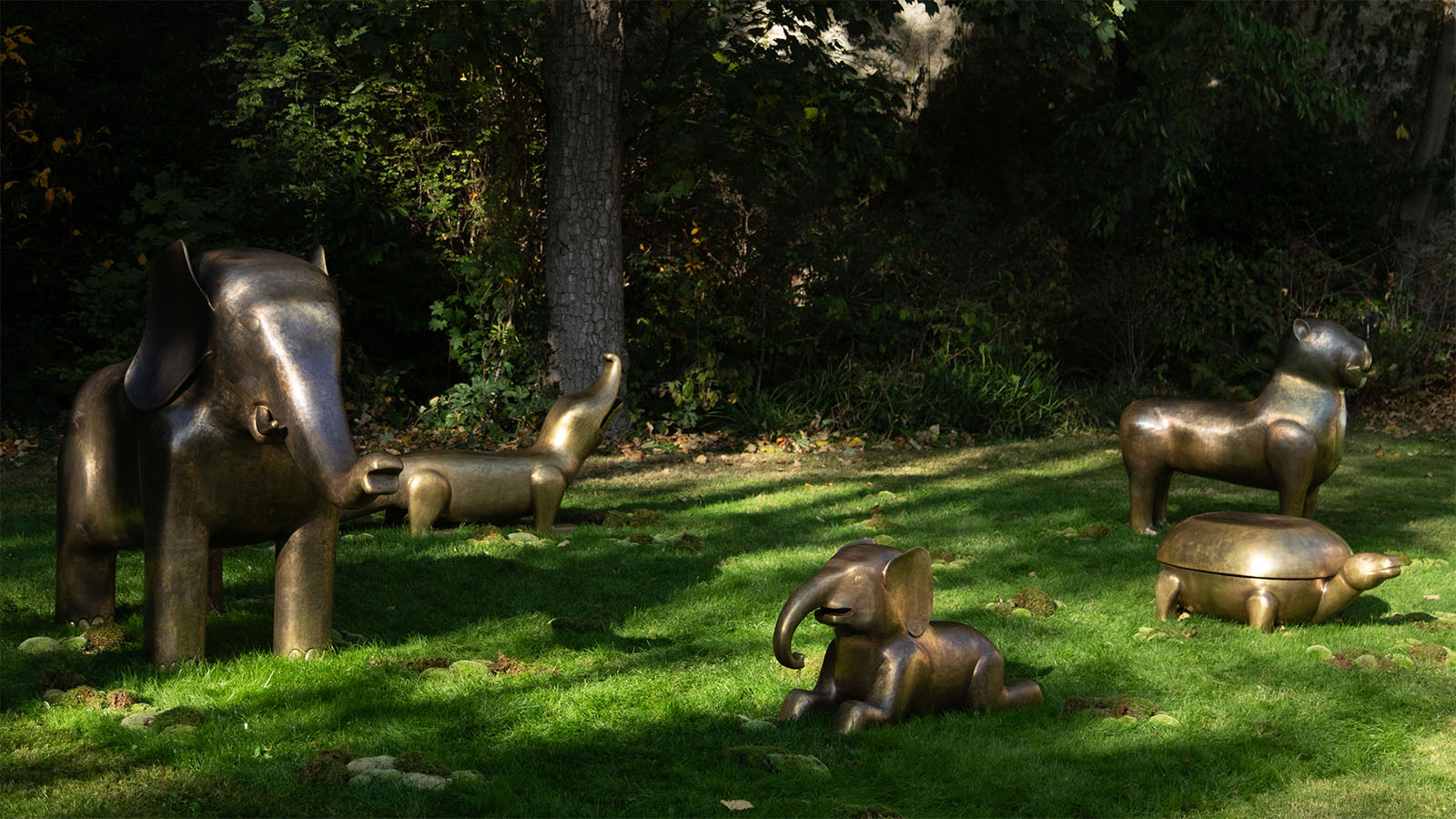
The Capitalyst: The Soul Garden at Design Miami Paris 2025 brought together five creatures from the Panchatantra, the tiger, elephant and calf, tortoise and crocodile, each embedded with repoussé narratives. Your collaboration with olfactory artist Sissel Tolaas introduced scent as a structural element, derived from molecular samples gathered across your workshop and natural habitats. You have described scent as the primary language of animals. What did working in an invisible, non-visual medium demand of your thinking that your previous practice had not?
Vikram Goyal: Working with Sissel Tolaas required a kind of unlearning. My practice has been deeply visual and tactile, scent operates in a completely different register. It is immediate, associative, and often subconscious.
What was challenging and exciting was thinking of scent not as an accompaniment, but as a structural element. It required us to consider how meaning is constructed when the primary medium is invisible. You cannot control it in the same way, it disperses, lingers, and even interacts with memory in unpredictable ways.
It also brought me closer to the non-human perspective. If scent is indeed a primary language for animals, then engaging with it allows us to access a different mode of storytelling, one that is less about representation and more about immersion.
The Capitalyst: Wrapped in History, the final chapter of The Great Elephant Migration, brought together over 70 blankets by 55 contributors, designers, fashion houses and Indigenous communities, ranging from Ralph Lauren and Sabyasachi to the Navajo Nation and Maasai, with proceeds supporting conservation NGOs. Your own Dreamscape Blanket drew from a 17th- century Rajput manuscript as a gesture of protection and good fortune. What was the curatorial logic behind placing such radically different visual languages into a shared format, and what did you observe about what each participant chose to express when given complete freedom within that constraint?
Vikram Goyal: The blanket, as a format, is both universal and intimate. It carries connotations of warmth, protection, and memory across cultures. By setting that as a shared constraint, we created a framework within which radically different visual languages could coexist.
The curatorial logic was not to homogenize, but to allow for plurality within a common ground. What was fascinating was how each participant responded to that freedom. Some leaned into their own cultural histories, others into abstraction or personal narrative. The constraint of the format did not limit expression, rather, it sharpened it.
What emerged was a constellation of perspectives, each distinct, yet connected through the underlying idea of care and protection.
The Capitalyst: Your forthcoming book, surveying Indian design post-independence, follows Shringara of Shrinathji, which was deeply rooted in your personal archive of miniature painting. This new work appears to be making a broader cultural argument. What is the central thesis of the book, and which narratives or contributors does it attempt to correct or recover?
Vikram Goyal: The book is in many ways, an attempt to map a more nuanced understanding of Indian design in the post-independence period. Much of the discourse has either been overly nostalgic, fixated on tradition, or overly derivative, looking outward for validation.
The central thesis is that there exists a rich, complex continuum of design thinking in India that has not been adequately documented or critically examined. This includes practitioners who have engaged deeply with material, context, and process, often outside the mainstream narratives.
It is also about recovering voices and practices that have been overlooked whether because they did not fit into conventional categories, or because they operated at the intersection of craft and design. The aim is to open up a more expansive conversation and not just create a definitive history.
The Capitalyst: You have been openly critical of contemporary Indian interior and furniture design as derivative, spaces that resemble international luxury without a material or cultural anchor. Over two decades, your own work has argued for the opposite through craft and process. In concrete terms, what has actually shifted in India’s design consciousness during that time, and where do you still see a persistent gap between intention and reality?
Vikram Goyal: There has certainly been a shift. There is greater awareness today of craft as a serious domain of design, not merely decoration. Younger designers are more willing to engage with material and process, and there is a growing audience that values that engagement.
However, the gap between intention and execution remains. Much of what is produced still tends to replicate global aesthetics without a deeper understanding of context or materiality. The language of luxury, in particular, often defaults to a kind of placelessness.
What is still needed is a more rigorous engagement with our own resources, both material and intellectual. That requires time, patience, and a willingness to move beyond surface-level appropriation toward something more grounded and original.

The Capitalyst: AI can now generate repoussé-like patterns instantly, simulate the sheen of worked brass, and render fully realized objects before any physical process begins. Your practice, by contrast, is built on time, labour and tacit knowledge, sometimes taking months to produce a single piece. How do you assess AI as a force acting on your field? Is it purely reductive, or are there specific ways in which it could meaningfully augment what you do without diluting its essence?
Vikram Goyal: AI is not inherently reductive, but it does operate on a fundamentally different logic. It can generate patterns, simulate materials, and accelerate ideation in ways that are undeniably powerful.
However, what it cannot replicate is the tacit knowledge embedded in the making, the resistance of the material, the decisions made in real time, the imperfections that give an object its character. Those are not inefficiencies, they are the essence of the work.
I see AI as potentially useful in the early stages like exploring form, testing compositions, even visualizing possibilities. But the core of the practice must remain anchored in the physical process. The risk lies in allowing the speed and ease of AI to flatten the depth of engagement that craft demands.
Used judiciously, it can be a tool. But it cannot and should not replace the intelligence of the hand.