The Capitalyst: You grew up in Allahabad among lawyers, studied Psychology, Philosophy and History, then joined the Foreign Service. Where did the novelist in you come from, and was there a moment you knew storytelling was inevitable?
Vikas Swarup: Allahabad in the 1970s was a city that told stories whether you wanted it to or not. It was the beating heart of Hindi literature — Munshi Premchand, Harivansh Rai Bachchan, Mahadevi Verma, Sumitranandan Pant, Firaq Gorakhpuri — these were not distant names on a syllabus, they were part of the air you breathed.
In university I opted for Psychology, Philosophy and Modern History. They weren’t a detour from writing — they were the long way in. You cannot write convincingly about human beings if you have not tried to understand how they think, what they believe, and the histories that have shaped them.
But I should be honest: growing up, I saw myself only as a reader, never a writer. That came much later. It was my posting in London, between 2000 and 2003, that changed everything. London is the world’s biggest hub for writing in English, and something about the city got under my skin. A few of my contemporaries in the Indian Foreign Service were also trying their hand at fiction around that time, and that was quietly encouraging. So I sat down and wrote. The result was Q&A, completed over two and a half months in a rather lonely house in Golders Green. And the rest, as they say, is history.
The Capitalyst: As a diplomat, you had unfiltered access to the real world: closed-door negotiations, geopolitical consequences playing out live. Yet when you sat down to write, you chose fiction. What pulled you toward the novel, and do you think diplomacy shaped your storytelling in ways a purely literary life never could have?
Vikas Swarup: Most people assume that a globe-trotting diplomat, someone who has sat in closed rooms while history was being made, would naturally gravitate towards the spy thriller. And I understand why they think that. But I have always been far more interested in ordinary people — what makes them take extraordinary risks, how they survive, what they carry inside them that the world never gets to see. That is where the real drama lives, as far as I am concerned.
And fiction gives you something no other form can. There are genuinely no limits. You can subvert the laws of physics if the story demands it. You can build an entirely new planet. You can go places that a memoir, a policy paper, even the most honest journalism cannot follow you. Only fiction could give me the freedom to fully chart the kind of life I wanted to put into words.
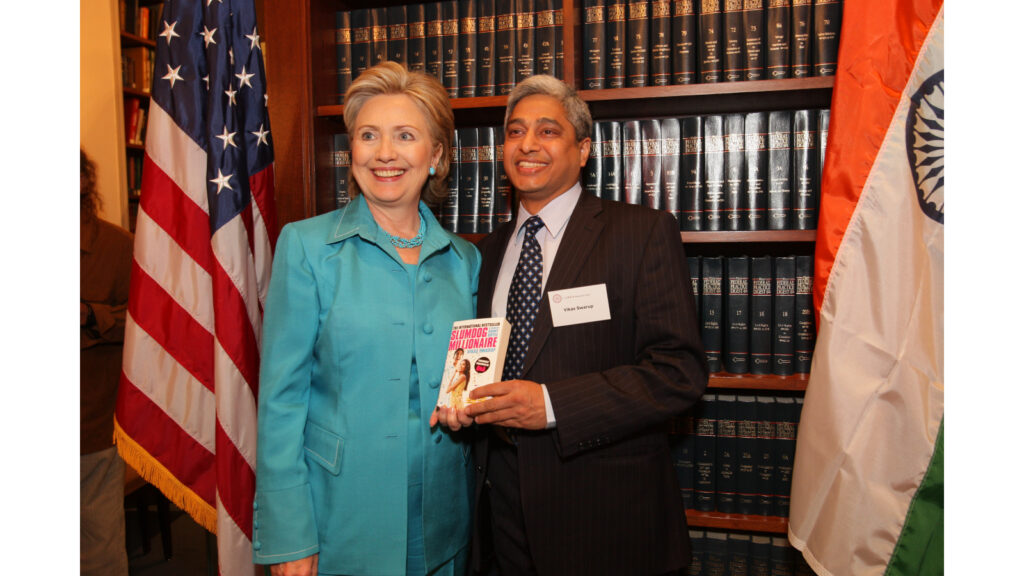
The Capitalyst: You served as High Commissioner to Canada, Consul General in Japan, and held postings in Washington and London. Does the character of a country change how its diplomats behave, or does the profession ultimately flatten everyone into the same careful, measured archetype?
Vikas Swarup: Yes, inevitably. Diplomats do not operate in a vacuum, they carry their country with them, its history, its anxieties, its ambitions, and even its unspoken habits of mind.
A nation that has known conflict may produce diplomats who are cautious, security-minded, and alert to threat. One that has prospered through trade may lean towards pragmatism and deal-making. Former colonial powers often display a certain institutional confidence, while post-colonial states can be more sensitive to questions of sovereignty and fairness.
But “national character” is not destiny. Professional training, multilateral norms, and individual temperament matter just as much. The best diplomats know when to reflect their country’s instincts, and when to transcend them.
In the end, diplomacy is a delicate balance, being faithful to where you come from, without being imprisoned by it.
The Capitalyst: Every author who sees their book adapted for screen faces the same moment of truth: does the film honour the story or hijack it? When the lights came on after you watched Slumdog Millionaire, what was your honest verdict?
Vikas Swarup: I was moved. Genuinely. Danny Boyle took the emotional core of the book — the idea that a child from nothing could carry within him the whole experience of his country — and he kept the narrative frame that I had always felt was the real heartbeat of the story: that you could reveal the entire private life of a protagonist through the very public medium of a quiz show. He put all of that on screen with extraordinary kinetic energy.
But the film is not the book. It was never going to be, and I made my peace with that. He made choices I would not have made. The one that stayed with me was the flattening of Ram Mohammad Thomas into Jamal Malik. Ram Mohammad Thomas is one of the most multi-dimensional characters I have ever written — his very name tells you something about the plural, contradictory, magnificent complexity of India. Jamal Malik is a simpler creature. A more cinematic one, perhaps, but simpler. That loss I did feel.
And yet — when A.R. Rahman’s music played and the story landed the way it did with audiences around the world, it was very hard to sit there and feel anything other than grateful. Eight Oscars later, I was not complaining.

The Capitalyst: Slumdog Millionaire won eight Oscars, yet the film sparked fierce debate in India about its portrayal of poverty. As both a diplomat and the original author, how did you navigate that controversy? Was there a moment it became personally uncomfortable?
Vikas Swarup: It was complicated, and at times, emotionally charged. On the one hand, the film took Q&A to a global audience. It opened doors, sparked conversations, and, in many ways, amplified the story beyond anything I had imagined. For that, I remain genuinely proud.
At the same time, I understood the discomfort within India. There is a long, serious debate about representation, who tells stories about poverty, for whom, and to what end. Those concerns do not come out of thin air. They are rooted in history, in questions of gaze and power, and in a fear that complexity can be flattened into stereotype.
My own intention with the book was very clear. I was never trying to document poverty or present a sociological study of slum life. The novel was written with deep affection for the ingenuity, humour, and resilience of people who survive against overwhelming odds. It was, above all, a story about possibility, about a boy navigating a brutal world with intelligence and hope. Poverty was the setting, not the subject.
I believe the film, in its own way, shared that instinct. It captured energy, momentum, and a certain irrepressible spirit. But cinema operates differently from literature. It is more immediate, more visual, and therefore more vulnerable to being read through the lens of spectacle.
The Capitalyst: Your short story in The Children’s Hours anthology fights violence against children, and you have written for publications from TIME to The Guardian. How do you balance diplomacy’s discretion with journalism’s demand for unfiltered truth?
Vikas Swarup: They are in permanent tension, and I have made my peace with that. Diplomacy trains you to weigh every word, to anticipate consequence, to understand that what is unsaid can matter as much as what is said. Those are not bad instincts for a writer to carry. In fact, they can sharpen your sense of nuance and restraint.
But discretion, taken too far, curdles into silence, and silence is useless on the page.
I was fortunate in one important respect. India’s civil service rules are remarkably enlightened. Technically speaking, you do not even need the government’s permission to write a work of literary fiction. That freedom is not trivial. It creates a space where imagination is not subject to prior clearance, where storytelling is not second-guessed before it is even born.
At the same time, I have never felt the need to be defensive about my work. My novels are not acts of exposure for the sake of provocation. If anything, they are anchored in a certain faith, in people, in systems, and in the imperfect but persistent logic of a democracy.
Because, in the end, my stories are about hope, about accountability, and about the slow, messy ways in which democracies actually work.
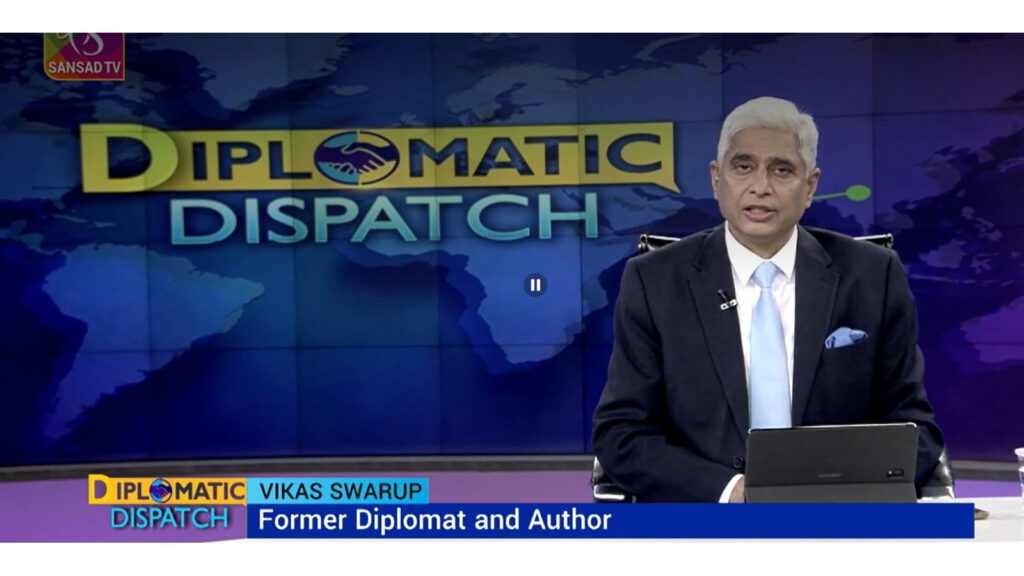
The Capitalyst: Hosting ‘Diplomatic Dispatch’ on Sansad TV demystified foreign affairs for everyday Indians. Were you able to achieve what you intended, and how did it reshape your view of public interest in diplomacy?
Vikas Swarup: More than I expected, honestly. I went in with a fairly modest aim, to demystify, to take something that Indians rightly sensed was important to their lives but often felt kept at arm’s length, and make it accessible. What I discovered was that the appetite was enormous. People were never intimidated by foreign policy, they had simply never been spoken to directly, in language that respected both their intelligence and their time.
It was also my first real exposure to television, and that, in itself, was an education. Television is an unforgiving medium. It teaches you very quickly how to compress your thoughts without diluting them, how to get to the point before the viewer’s attention drifts. It forces discipline, in time management, in structuring an argument, in knowing when to stop.
The Capitalyst: After novels that became global films, a diplomatic career spanning five continents, and a hit TV show, what is keeping Vikas Swarup busy today? And what should we be watching out for next?
Vikas Swarup: Retirement, as it turns out, is not an ending so much as a widening of the field. It opens up a different kind of space, one that is less structured, but in many ways more demanding, because you now have to decide how to fill it with purpose.
Since then, I have been creating full time, which is both liberating and exacting in equal measure. Writing, as you know, is not a pastime, it is a discipline. Alongside that, I spend time mentoring students, which I find deeply rewarding. There is something energising about engaging with young minds who are curious, questioning, and unburdened by the habits of official thinking.
I also do the occasional lecture, which allows me to stay connected to the world of ideas and public conversation. And, of course, there is the never-ending stream of requests for comments on the geopolitical topic du jour, which seems to arrive with unfailing regularity.
As for what comes next, there is a new novel taking shape. I’m quite excited by it. So watch that space.