The Capitalyst: Your family co-founded STIC Travel Group, one of Asia’s leading travel and tourism companies, and you spent the first twenty years of your career there as executive director before leaving in 2018 to pursue gems and jewellery full time. Twenty years is a long runway to walk away from a family business. What was the actual tipping point that made you finally leave, and did your family understand the decision immediately, or did you have to make the case for it?
Richa Goyal Sikri: Self-realisation takes time and is one of the most difficult things to attain. I started visiting gemstone mines and manufacturing centres in 2014 while I was working in our family business, purely to better understand the journey of a precious stone from mine to market. One experience led to another, and soon I found I was spending my evenings after a full day’s work pouring over gem and jewellery books. It was only after three years of independent self-sponsored travel and research I decided to leave my family business in 2018. There was no tipping point but a continuous increase in this volume that I needed to immerse myself in this world. The volume became so high that I simply couldn’t ignore it anymore.
The Capitalyst: Your mother became an English Literature lecturer at Delhi University at just twenty-one in the early seventies, before going on to co-found STIC alongside your father. You’ve written about watching her commission and collect jewellery rather than inherit it. How much of your own relationship with gemstones, choosing pieces deliberately rather than treating them as passed-down heirlooms, do you trace directly back to watching her do the same?
Richa Goyal Sikri: My mother’s love of ancient history, her command over the English language, her trained eye in selecting jewels, all had a significant impact on the development of my taste. Alongside my mother, it was also one of her closest friends, Jessie aunty, who collected gemstones, designed her own jewellery and commissioned incredible pieces. I would spend hours at the jewellery salon with her.

The Capitalyst: Your first real entry point into this industry was curating an educational travel experience to sapphire and moonstone mines in Sri Lanka back in 2013 or 2014, years before you left tourism professionally. That’s an unusual bridge, using your existing travel expertise to access a completely different industry from the inside. Looking back, was that trip a calculated first step toward a second career, or did you only recognize its significance after the fact?
Richa Goyal Sikri: I didn’t think much of it at that time. I had just finished a private workshop on gem treatments in Singapore and the gemologist who conducted the course wanted to see the sapphire mines in Sri Lanka. I volunteered to curate and execute the trip for her and few of her students. I never in my wildest dreams thought that trip would lead to a second career.
The Capitalyst: You built your public storytelling voice on Instagram starting in 2017, and it’s now the base from which brands, publications and institutions all found you. Journalism and storytelling in this industry has traditionally run through trade magazines and established mastheads, not personal social accounts. What did building an audience organically on Instagram let you say or show that you don’t think a traditional gems and jewellery publication would have allowed?
Richa Goyal Sikri: I created the Insta account to purely serve as an online scrapbook of my learnings and experiences. Editors finding me via Instagram, commissioning articles, and recognition from the industry, which led to my work as a digital storyteller, all happened organically. I think my audience grew because I was doing something that had never been done before, storytelling about gems, mining, and the business. The content was created from my point-of-view as a confused collector trying to make sense of it all. There was a raw authenticity to the content, which I continue to try my best to maintain.

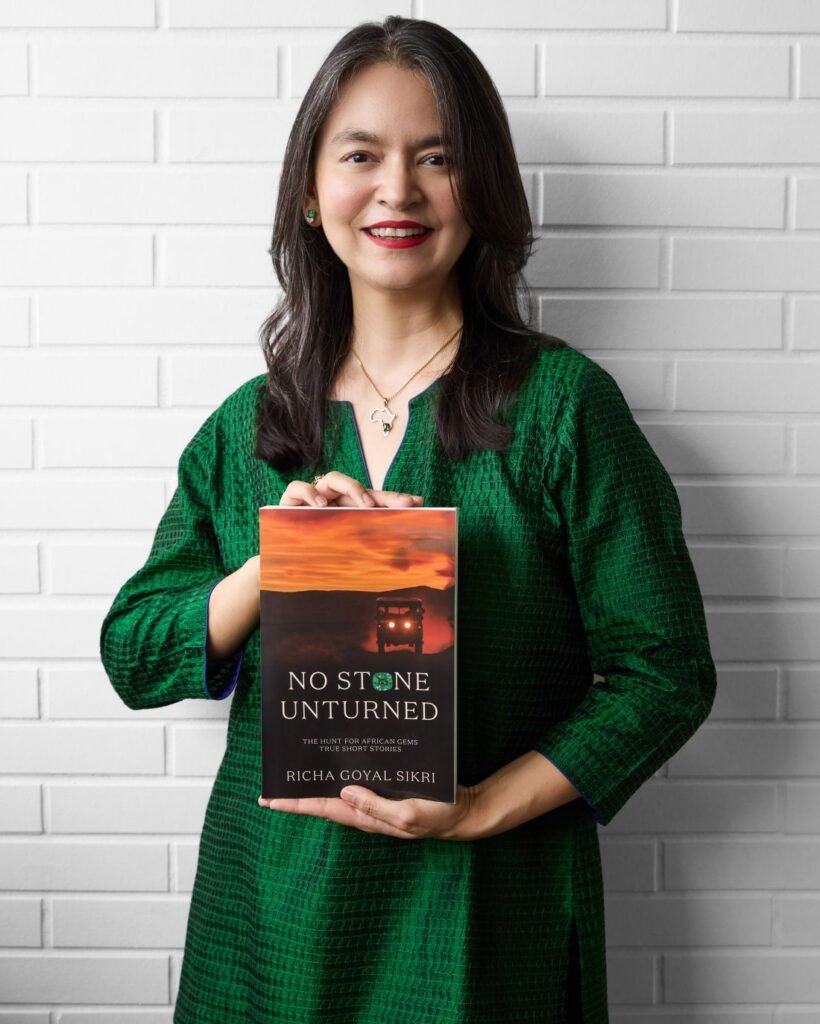
The Capitalyst: Gemfields commissioned you in 2020 to deliver twenty stories and 100,000 words for what became your debut book, and you ended up delivering twenty-four stories and nearly 146,000 words, four years later than planned. What made you keep going past the brief instead of simply delivering what was commissioned, and was there a specific story among the twenty-four that you almost didn’t include but ultimately couldn’t leave out?
Richa Goyal Sikri: Due to the nature of the stories there was this constant sense of responsibility. Each time I would decide to finish the manuscript, another story would fall in my lap. The last story I worked on, which almost didn’t make it was the origin story of the world’s largest ruby mine in Montepuez, Mozambique. It’s a controversial location due to heavy conflict, too complicated to explain in this answer. One of the main contributors got cold feet and refused to sign the release that I needed to include the story. It took many conversations to finally convince him, and I am so happy I pushed myself to write and get the necessary permissions to include it in the book.
The Capitalyst: “No Stone Unturned” takes readers through the coloured gemstone trade in Africa, an industry you’ve described as full of people who aren’t in it for the money, who keep laughing and smiling despite an often misunderstood and difficult business. As an outsider gaining access to that world, what did you have to prove before people were willing to be that open and vulnerable with you?
Richa Goyal Sikri: Honestly, I think they recognised the malaise in my eyes when I would talk about gemstones. They could straight away see that I was a fellow addict. The connection was immediate. I think it also helped that I wasn’t a trader, but a storyteller who was willing to invest my time and resources to understand their point of view and represent it accurately.
The Capitalyst: You hold formal GIA qualifications in coloured stone grading and gem identification on top of your commerce and MBA background, giving you both the technical credibility of a gemologist and the storytelling instincts of a journalist. When those two ways of seeing a stone genuinely conflict, when the technical grading tells one story and the human history behind the piece tells another, which do you trust more in your own writing?
Richa Goyal Sikri: It depends on the context, the goal of the piece that I am working on, and it depends on the stone. I am always looking for life in a stone beyond the technical parameters of colour, clarity, cut, carat weight. The 5th C of character for me is the most important and the most elusive element. I try to present the intersection of the technical, cultural and human aspect of a gemstone.
The Capitalyst: Your work spans an enormous range of institutional voices, from the Art Science Museum in Singapore and the World Emerald Symposium in Colombia to Vogue, Harper’s Bazaar, and Buccellati. Writing for a museum audience and writing for a luxury fashion audience require fundamentally different registers, one is about heritage and preservation, the other about desire and status. How do you decide which version of your voice a given piece calls for?
Richa Goyal Sikri: You start with the brief that the person commissioning your work provides. I think about the audience, let that be the guide.

The Capitalyst: You’ve written about your own first independent jewellery purchase in your late twenties, feeling “slightly at sea” and finding it strange to reduce a piece to gold weight or carat count rather than treating it as what you’ve called a miniature work of art. Now that you help other collectors navigate exactly that same uncertainty, what’s the single most common mistake you see first-time buyers make that you wish someone had warned you about at the start?
Richa Goyal Sikri: Before I answer, I would like to clarify that I am not a gem or jewellery merchant or broker. Collectors can gain my insights by following me on on Instagram, and my other writing projects (articles, book, talks). There are a few common mistakes: 1) Assuming that just because they are buying jewellery, it will automatically hold and appreciate in value over time, 2) Thinking that the origin of a gemstone (Colombia for emeralds, or Burma/Myanmar for rubies) guarantees quality. 3) Not doing their independent homework.
The Capitalyst: Between your book, your Instagram platform, and your ongoing work with institutions like GJEPC, GemGenève and the Natural Diamond Council, you’ve built something that functions less like a single job and more like an entire second career built from scratch after twenty years in a different industry. What does the next chapter of that second career actually look like for you, and is there a story in the gem world you still haven’t told that you’re determined to get to eventually?
Richa Goyal Sikri: I never plan ahead. I only go where the gem gods take me. They have done a significantly better job in navigating my journey than I ever could. We have to learn to surrender control and just listen to our gut, and trust in the universe and it’s energy to bring us to the path intended for us and keep us there.