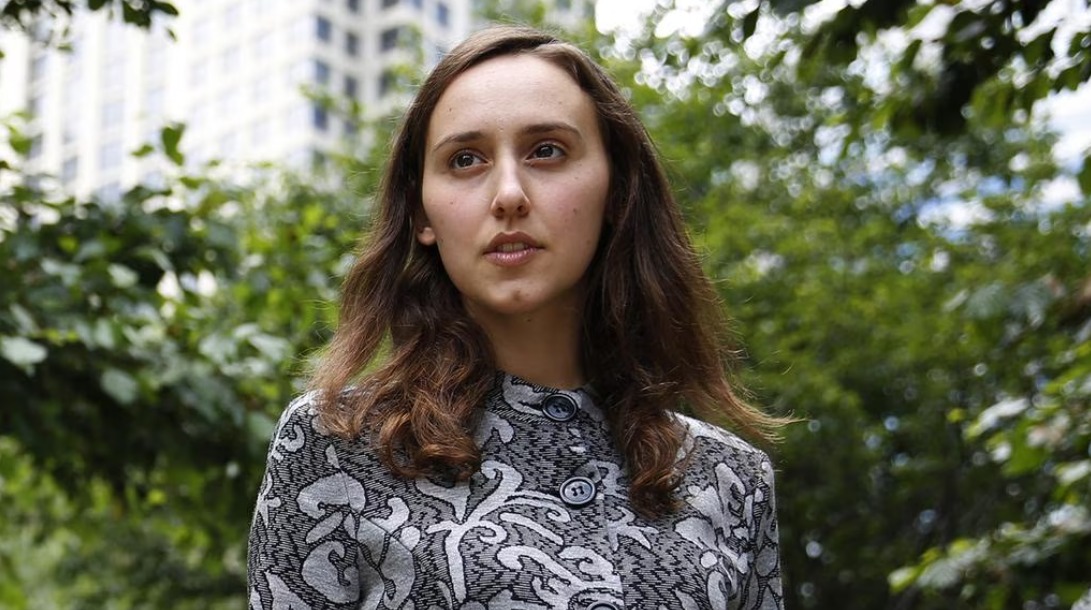
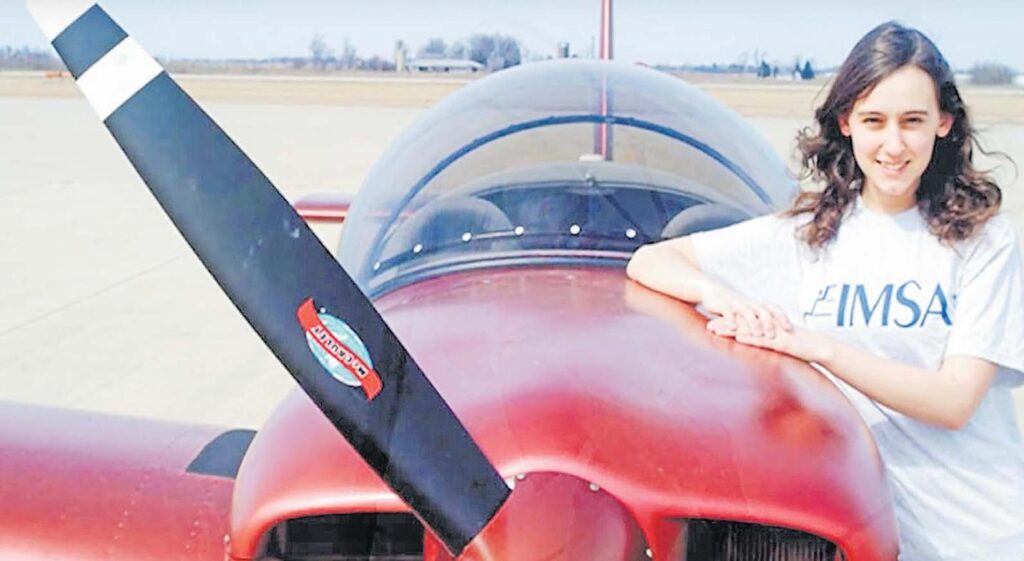
At 14 years old, Sabrina Gonzalez Pasterski sat at the controls of an airplane she built with her own hands, soaring over the Chicago skyline. For most teenagers, building a model airplane from a kit is ambitious. Sabrina constructed a fully functional aircraft from scratch and piloted it solo before she could legally drive a car.
This wasn’t just a remarkable feat of engineering for someone so young. It was a preview of a mind that would soon challenge our fundamental understanding of the universe. Today, Sabrina Pasterski stands at the forefront of theoretical physics, exploring the deepest mysteries of quantum gravity and black holes. Dubbed by some as “the next Einstein,” she represents a new generation of scientists whose relentless curiosity and unconventional paths are reshaping how we think about space, time, and reality itself.
Teenage Trailblazer: When Rejection Fueled Determination
Sabrina’s journey into the stratosphere began long before her solo flight. Between ages 12 and 14, she spent countless hours in her family’s garage constructing a Van’s RV-10 aircraft, meticulously following blueprints and solving engineering challenges that would stump most adults. When she completed the plane and flew it at 14, the Federal Aviation Administration took notice, and so did the academic world.
Despite this extraordinary achievement, Harvard initially waitlisted her application. The irony wasn’t lost on anyone: a teenager who could build and fly her own airplane wasn’t deemed a sure bet for admission. MIT, however, recognized her potential immediately, and Sabrina chose Cambridge over Cambridge, enrolling at the Massachusetts Institute of Technology with clear purpose.
Her high school years at the Illinois Mathematics and Science Academy had already marked her as exceptional. As a US Physics Team semi-finalist and standout student at one of the nation’s premier STEM schools, she demonstrated that her talents extended far beyond the mechanical into the theoretical realm where she would ultimately make her mark.
Academic Excellence and Ground-breaking Research
At MIT, Sabrina Pasterski dominated from day one. She completed her undergraduate physics degree in just three years, graduating in 2013 with a perfect 5.0 GPA and becoming the first woman in two decades to top the department. The prestigious Orloff Scholarship followed, along with internships at NASA’s Kennedy Space Center and research at CERN’s Compact Muon Solenoid experiment. These weren’t resume builders but foundational experiences preparing her for revolutionary work ahead.
Her Harvard PhD years proved transformative. Working under Andrew Strominger, she tackled quantum gravity’s deepest mysteries. In 2015, as a graduate student, she published solo work on the spin memory effect that caught Stephen Hawking’s attention. He cited her research in his own black hole investigations, a nearly unprecedented achievement for someone still pursuing their doctorate.
This work formed the PSZ triangle, named for Pasterski, Strominger, and Alexander Zhiboedov. Their discoveries about gravitational memory effects revealed permanent spacetime changes from passing gravitational waves, with profound implications for understanding black holes and universal symmetries. The Hertz Fellowship gave her freedom to pursue these ambitious questions without pressure for safe, incremental results. She completed her 2019 PhD with another perfect GPA.
After a Princeton postdoc, Sabrina made a surprising choice at 27. She turned down Brown University’s $1.1 million faculty offer to join the Perimeter Institute for Theoretical Physics in Waterloo, Canada. While less famous publicly than Ivy League institutions, Perimeter is legendary among physicists as a place where ambitious minds tackle the hardest problems. There, she could lead the Celestial Holography Initiative without institutional constraints, following the physics rather than the prestige.
The Entrepreneurial Physicist: Building Ideas Like Airplanes
Sabrina’s first entrepreneurial venture wasn’t in the traditional business sense, but it carried the same spirit of innovation and risk-taking. Just as she had built an airplane from raw materials and blueprints, she approached theoretical physics with an entrepreneur’s mindset: identify an unsolved problem, develop a novel solution, and deliver something of value to the world.
The ‘product’ she created was groundbreaking research itself. Her work on the Pasterski-Strominger-Zhiboedov Triangle wasn’t just an incremental improvement on existing theories. It was a fresh framework for understanding spacetime, black holes, and quantum gravity that challenged established paradigms. In a field dominated by decades-old theories and institutional thinking, her solo papers represented the academic equivalent of a startup disrupting an entrenched industry.
This entrepreneurial approach caught attention beyond academia. When Jeff Bezos tried to recruit her for Blue Origin, he recognized what many venture capitalists look for: someone who can see possibilities others miss and execute on ambitious visions. Her ability to combine aviation knowledge, engineering skill, and theoretical physics made her uniquely valuable. She could bridge the gap between the abstract mathematics of quantum gravity and the practical challenges of space exploration.
What sets Sabrina Pasterski apart is her willingness to take intellectual risks that tenured professors often avoid. Publishing solo papers as a graduate student, pursuing quantum gravity questions considered too ambitious, and later choosing research freedom over prestigious positions all reflect an entrepreneurial tolerance for uncertainty in pursuit of breakthrough discoveries.
Personal Philosophy: A Quiet Revolution
Despite the “next Einstein” labels and media attention, Sabrina Pasterski maintains a remarkably grounded perspective. She’s spoken about the pressure that comes with hype, the imposter syndrome that can accompany early success, and the importance of balancing intense intellectual work with rest and sleep.
Her approach represents what some have called a “quiet revolution” in theoretical physics. It’s less about self-promotion and more about letting the work speak for itself. As a first-generation physicist from a Cuban-American family, she’s also keenly aware of her role in inspiring young people who might not see themselves reflected in traditional images of scientists.
She didn’t set out to be a role model, but her journey from that garage-built airplane to the frontiers of quantum gravity shows what’s possible when curiosity meets determination.
What’s Next: Unfinished Business with the Universe
As Sabrina continues her work at Perimeter, the questions she’s pursuing may reshape physics as profoundly as Einstein’s relativity did a century ago. Can celestial holography unify quantum mechanics and gravity? Will satellite tests confirm gravitational memory predictions? What other secrets hide in the symmetries of spacetime?
Whatever answers emerge, one thing is certain: Sabrina Gonzalez Pasterski will be at the center of discovering them.
For aspiring scientists reading this, her message is clear: build your airplane, whether literally or metaphorically. Pursue the questions that fascinate you, even when others doubt. The universe rewards bold curiosity with extraordinary discoveries.