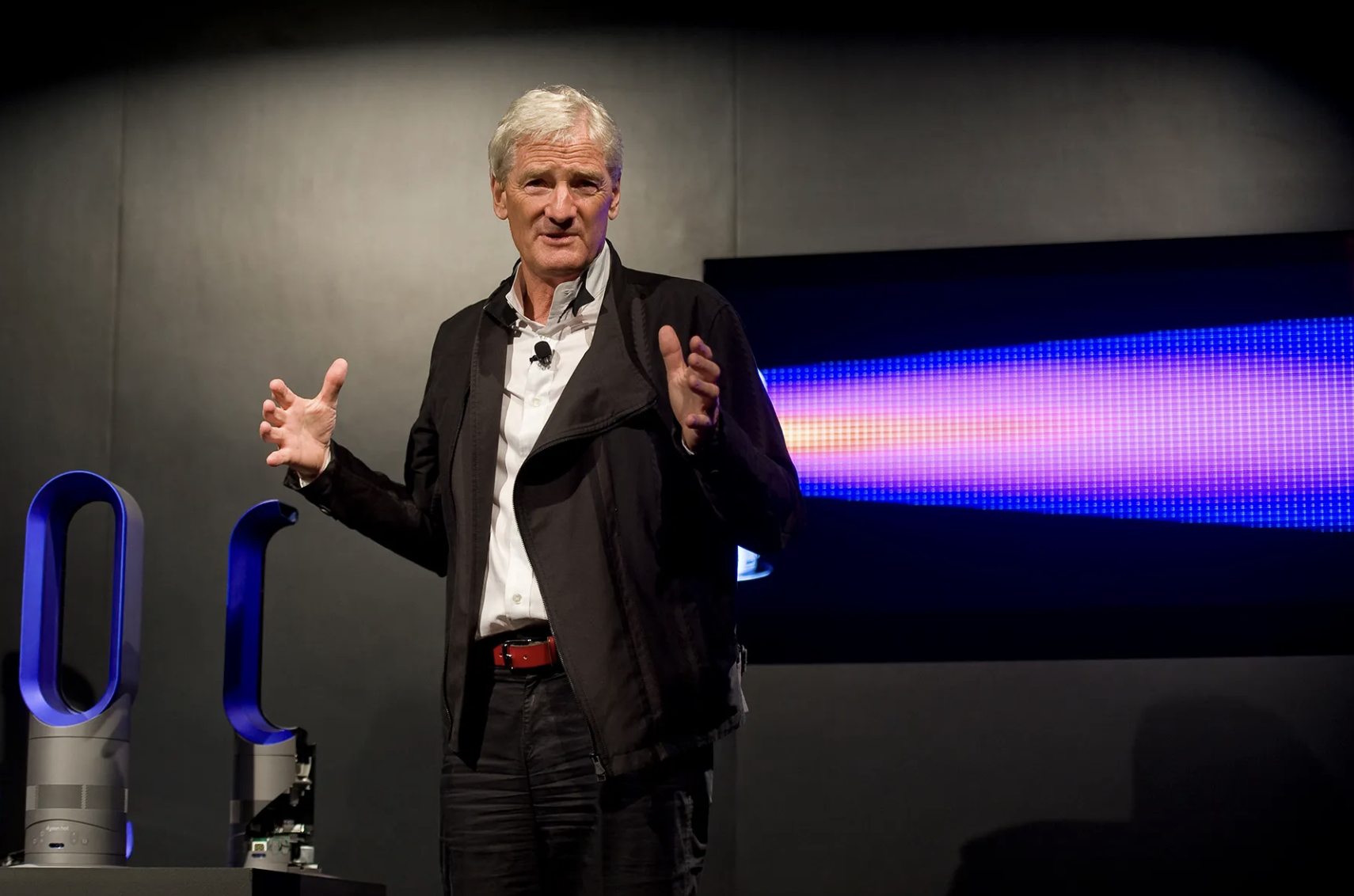
In the quiet countryside of Norfolk, England, a young boy once spent hours dismantling bicycles and trying to understand how things worked. That boy, James Dyson, would grow into the mind behind one of the world’s most inventive and design-focused technology companies — Dyson Ltd. His name, now synonymous with sleek engineering and imagination, wasn’t built overnight. It was forged through a mix of failure, risk, obsession, and the kind of persistence that only comes from an inner restlessness to make things better.
Dyson’s story is not just about engineering marvels or successful patents. It’s about a man who refused to give up — even when the odds, finances, and experts were firmly against him.
Early Life: The Making of a Problem-Solver
James Dyson was born in 1947 in Cromer, Norfolk. His father was a schoolteacher, and his mother encouraged creativity at home. Dyson grew up influenced by a simple curiosity — a deep fascination with how machines functioned. He was not a top student, but he had one clear strength: when confronted with a problem, he had to solve it.
At the age of nine, his father passed away, an event that quietly shaped his resilience. Left to find his own way, Dyson learned early that independence was key to survival. He later studied at the Royal College of Art in London, where he initially trained in furniture and interior design before his focus shifted toward industrial design — the intersection of creativity and engineering.
His teachers quickly realized his unusual approach to form and function. Dyson wasn’t content with just making things look beautiful; he wanted them to work better. That curiosity became a lifelong compass.
The Seed of Innovation: Ballbarrow and Early Struggles
Before the Dyson vacuum cleaner became a household name, James faced a series of entrepreneurial missteps. In the early 1970s, he came up with the Ballbarrow — a wheelbarrow with a large plastic ball instead of a wheel. The idea was practical: it allowed the barrow to move easily on mud and uneven ground. He patented it and introduced it to the market, but the business side was unkind. His partners took control, and Dyson was eventually pushed out of his own company.
It was a crushing setback. The experience, however, taught him something lasting — that innovation often conflicts with business convention. It also planted an idea in his mind: he needed to build something himself, on his own terms, even if it meant living on a knife-edge financially.
The Turning Point: The Birth of the Bagless Vacuum Cleaner
The eureka moment came from frustration — specifically, frustration with his vacuum cleaner. In the late 1970s, Dyson bought a vacuum that seemed to lose suction after every cleaning session. When he opened it, he found the bag clogged with dust. A simple domestic irritation turned into a life-defining realization.
He wondered: if sawmills used cyclonic separation to remove dust from the air, why couldn’t a similar principle be applied to a vacuum cleaner?
In 1979, he began experimenting in his backyard workshop. Using cardboard and duct tape, he built his first prototype — a rudimentary machine that separated dust without a bag. It was messy, noisy, and far from perfect, but it worked.
Yet this marked only the beginning of his true challenge. Dyson would go on to create 5,127 prototypes over a span of five years, testing, tweaking, and failing — until finally, he got one right. It was not engineering that broke him; it was the wall of rejections that followed. Every major vacuum manufacturer turned him down. The idea was too disruptive. Disposable bags were too profitable for the industry to give up.
The Years of Isolation and Grit
For years, Dyson faced personal and financial turmoil. His wife, Deirdre, supported the family on her art teacher’s salary while he sank all his money into prototypes that no one wanted to manufacture. Their kitchen became a workshop, parts lying around like constant reminders of struggle and hope intertwined.
It was during these years of solitude and rejection that Dyson’s character showed its true depth. His mantra became simple: “Don’t just wait for someone else to discover you. Keep going until they can’t ignore you.”
Finally, in 1983, Dyson took a daring step. Unable to find support in Britain, he launched his vacuum cleaner in Japan through a mail-order catalogue. Marketed as the “G-Force”, it was sleek, futuristic, and expensive — costing nearly $2,000. To everyone’s surprise, it was a hit. The Japanese market appreciated design and innovation, and Dyson won the 1991 International Design Fair Prize in Japan. With that momentum, he finally had proof that the world was ready for his invention.
Building Dyson Ltd: A Revolution Begins
In 1993, James Dyson launched Dyson Ltd, setting up his first manufacturing plant and research center in Malmesbury, England. The same year, he released the Dyson DC01, his first vacuum cleaner for the mass market. It was transparent — allowing users to see the dust spinning inside — a bold move in design and marketing that celebrated function rather than hiding it.
Dyson turned his frustration into a philosophy: “Make things that work better.” His designs weren’t just appliances; they were statements of engineering integrity. The market responded rapidly. By the early 2000s, Dyson’s vacuums were outselling competitors in multiple countries. He had defied powerful corporations, built his brand independently, and reshaped household technology.
Beyond the Vacuum: Reinventing Everyday Machines
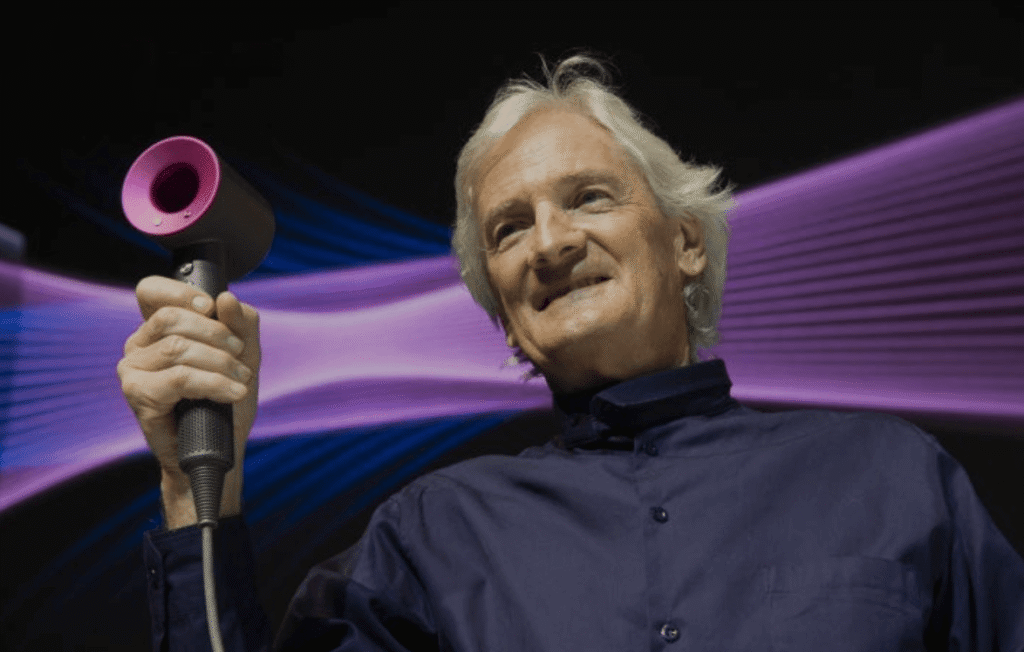
Dyson never settled for one success. His company began branching into other household appliances — all built around solving small annoyances through engineering excellence. From ** bladeless fans (Air Multiplier)** to the Supersonic hair dryer, Airwrap stylers, and Dyson Purifier series, each product carried the same essence: bold design backed by real invention.
The same rebellious curiosity that inspired his first vacuum cleaner now drove Dyson to rethink air quality, heating, lighting, and even robotics. In 2018, Dyson invested heavily in electric vehicle development and solid-state battery research — though that project was later shelved. Even that “failure” became an important expression of Dyson’s philosophy: innovation means experimenting, even if it leads nowhere immediate.
The Global Brand and Its Cultural Identity
Today, Dyson is a global empire employing over 14,000 people around the world, including thousands of engineers and designers. Its research facilities stretch from England to Singapore and Malaysia. The company’s sleek aesthetic and commitment to R&D — reinvesting a large portion of profits into innovation — make it stand out in a marketplace often dominated by incremental updates and cost-cutting.
At the core of Dyson’s culture is that restless inventor’s mindset. Employees are encouraged to prototype, to fail, to test ideas without fear. Dyson’s global success isn’t just built on clever design; it’s rooted in a culture that celebrates curiosity and grit.
The Emotional Undercurrent: Perseverance Over Perfection
Behind every polished Dyson product lies an emotional narrative of perseverance. James Dyson often describes himself not as a businessman but as an engineer who just refused to stop. His failures — whether with the Ballbarrow, countless vacuum prototypes, or the electric car project — all fed into his success. They were all data, lessons, steps toward something better.
He also resisted the easy path. Turning down early acquisition offers, keeping Dyson privately owned, and maintaining core operations in the UK were all decisions of conviction. He wanted control over innovation, not boardroom approval. He famously believed that true invention only happens when you can afford to make mistakes — something publicly traded companies seldom tolerate.
Personal Side: A Quiet Visionary
Offstage, Dyson remains private. He and his wife have lived quietly, away from the media frenzy, focusing on philanthropy and education. He established the James Dyson Foundation to promote design and engineering education among students, and the Dyson Institute of Engineering and Technology, which merges academic study with real-world experience inside the Dyson company.
He often reflects on his early struggles as lessons worth having. They were his training ground — not in business, but in patience, humility, and creative resilience.
Legacy: Redefining Success Through Persistence
James Dyson’s legacy goes beyond a brand name on household gadgets. It’s a reminder that true innovation rarely fits comfortably within corporate boundaries. It demands stubbornness, risk, and vision.
From that workshop filled with cardboard prototypes to a billion-dollar company spanning the globe, Dyson’s life demonstrates an almost poetic symmetry: a man who built machines that never lost suction, because he himself never ran out of energy. In an age of shortcuts and rapid gratification, his journey stands as testament to an older truth — that greatness often begins with frustration but is sustained by persistence.
Closing Thought
As Dyson himself once said in an interview, “Failure is interesting. It’s part of making progress. Success, on the other hand, is boring.”
That statement captures the heart of his philosophy — that innovation is not a straight line but a series of determined recoveries. James Dyson’s story isn’t about building a vacuum empire. It’s about never giving up on the pursuit of improvement, even when the world says you’re wrong.
His machines may clean our homes, but his story cleanses something deeper — our belief in what human perseverance can achieve.