The Capitalyst: You’ve become one of Britain’s most recognizable satirists through The Revolution Will Be Televised. Can you take us back to the moment you realized that comedy could be a weapon for social commentary? Was there a specific event that ignited your satirical approach?
Jolyon Rubinstein: I don’t know if there was a specific event, but for me, satire is the lens through which I choose to see the world. I mean this on a profound level. It’s how I manage to function. When I see something awful, terrible, or disturbing happening in the public sphere, I think, God this is awful, BUT I can flip that into something that matters, that gets to the hidden truth of the matter. The hypocrisy, or the corruption or the greed. There was a moment, when I first started making the show for the BBC, when I realised that if I was feeling something and you were feeling something, it was likely that many, many other people were feeling the same way – That’s the power of satirical comedy—to touch that lightly, through understanding and laughter. I think that’s how one changes hearts and minds—through recognition and laughter—this is the special power that satire possesses.
The Capitalyst: The Revolution Will Be Televised was famous for its audacious undercover stunts—from infiltrating political events to creating elaborate hoaxes. Can you walk us through how you conceived, planned, and executed one of your most memorable pranks?
Jolyon Rubinstein: It always starts with the story — the journalism. After that, it’s about whether you can flip the news story into something really hilarious. Sometimes, you can have a great story and just not see the angle. Particularly on The Revolution will be Televised, we worked with a team of incredible ninjas —mystical beings who were able to convince those in charge of events to allow us in. I’m never going to be able to reveal their secrets, but let’s just say a Surrey accent and a middle-class laugh go a long way. That – and the fact we had racially profiled ourselves – two white men with middle-class accents and suits can get away with almost anything (this is NOT a good thing – but is true none the less). Once, we attended the Manor House speech, an event that takes place in the heart of the City of London, where the Chancellor of the Exchequer speaks to the gathered dignitaries. George Osborne was the Chancellor at the time, and we realised he didn’t even have a GCSE in maths. So, we gave him a GCSE maths textbook because we knew one picture of that would help the story travel. The next day, it was on the front page of the Daily Telegraph—a spoonful of comedy sugar helping the fact medicine go down.
The Capitalyst: You co-founded Jolly Griffin Ltd—walk us through the origin story. What gap in the media landscape did you and your co-founders spot, and how did your BAFTA-winning satire background influence the company’s DNA from day one?
Jolyon Rubinstein: As the name suggests, we’re two people: myself and BIFA-nominated and Screen Star of Tomorrow producer Anna Griffin, whose two most recent feature films—Calibre, which launched Jack Lowden, and Sister Midnight, which was nominated for a BAFTA last year—are quite extraordinary. You can sum up our company’s slate in one statement: “I can’t believe it.” We’re growing a diverse, topical, and provocative slate of really gorgeable dramas that audiences are really going to lap up. We often develop stories that have already gone massively viral and already are in the public consciousness that can be turned into drama. It’s not very different to what I was doing in comedy. It’s just this time I’m making drama. I am particularly interested in these dark times in the nature of our internet-mediated lives. As you say, we’re living in a world of fake news, where truth is often stranger than fiction. But that political polarization is a constructed reality, which has benefited those on the right who would like to exert power upon us. It’s a subject I am very interested in exploring in my work currently.
The Capitalyst: What are you working on right now at Jolly Griffin, and how has your approach to satire evolved in the age of social media, fake news, and political polarization? When reality often seems more absurd than satire, how do you stay relevant and impactful?
Jolyon Rubinstein: Although I can’t speak on our specific TV projects that are in development, I can tell you that we are very excited about them, that we are currently developing with some of the world’s most famous actors, and that this theme of how ordinary people are radicalized online – is central to what we are working on. I’m more interested in shining light onto the radicalization of everyday people— you and me, and everyone who might think we might be immune.
I can tell you about two features that I have written, one that I hope will be my directing debut called LITTLE BOATS (think Four Lion’s for the Far Right and you’ll understand the tone), and SKIMMERS which is supported by Climate Spring, a global narrative change organisation that is working to transform how the climate crisis is represented in film, television and popular culture. It’a sports comedy drama with an environmental twist set in the incredible world of the Stone Skimming World Championships… Where everyone takes it as seriously as the Olympics and thinks they are Usain Bolt!
You’ve got to have some light with the shade!
The Capitalyst: Winning a BAFTA and four Broadcast Awards is extraordinary. Which recognition meant the most to you personally, and why? Was there a project or piece of work that you felt was underappreciated or that audiences did not quite “get” at the time?
Jolyon Rubinstein: Nothing prepares you for the feeling of winning a BAFTA. There’s no doubt that meant the most to me personally, because it all felt impossible then. The first time I worked in television, I wrote and performed my own show; I couldn’t even get a running job. As a dyslexic with undiagnosed ADHD, I found it extremely difficult to get a foothold in the industry whatsoever. But through making our own stuff, we managed to gain traction and be able to show people that that’s what it was like.
Although I felt all the work to date has been appreciated, I think BREXAGEDDON, released only 25 days after the vote, was an extraordinary achievement and almost operates as a time capsule. Although my Spotify Original show, WE NEED TO TALK ABOUT, which is still available, is painfully relevant now as it was then, as we tracked issues which, unfortunately, have become more and more central to the public square debate about the rise of transnational networked fascism.
The Capitalyst: Comedy and satire are walking tightropes in today’s climate. How do you navigate the balance between being provocative and being responsible? Have you ever crossed a line that you regretted, or conversely, held back on something you wish you had released?
Jolyon Rubinstein: The rule for me is twofold: Is it in the public interest? And does it punch up? And if both of those are yeses, then you’re usually on the right path. Sure, there’s a balance, but nothing should ever be off the table with satire—be it religion, politics, sex, equality, all of it.
We caught a lot of flack for a particularly potent satirical take on “The Real Housewives of Beverly Hills,” called “The Real Housewives of ISIS.” Some idiots felt this was a comment on Islam, rather than quite clearly being a comment on ISIS, who are a death cult. It’s a bit like saying doing a sketch on Christianity would be the same as doing the Ku Klux Klan, who claim to be God’s warriors. It makes no sense at all.
There was a lot of material that we weren’t able to make legally permissible in the show. Once, I chased down Donald Rumsfeld in an oil and gas conference in Montana, but wasn’t able to use the footage. No one else major got away from us.
Oh, and the BBC wouldn’t let us put a statue of Jimmy Saville in the Vatican…
The Capitalyst: For aspiring entrepreneurs watching from garages or home offices, what is the mission driving Jolly Griffin, and how do you balance commercial gigs with pure creative satire without selling out?
Jolyon Rubinstein: As a storyteller, you’ve got to follow your heart, not your head. Your gut is telling you what you need to make; your head tries to rationalize it. It’s a very difficult mix, and if you can avoid it altogether, I would. Jolly Griffin is looking at film, TV, but we’re also involved in the vertical drama space, as well as online content that I make often for the likes of Amnesty International and Greenpeace. You’re never selling out if you’re telling stories you want to tell; that surely has to be the guiding light.
The Capitalyst: Looking ahead, what is the one story you feel urgently needs to be told through satire right now? And if you could pull off one dream stunt or project with unlimited resources and no legal consequences, what would it be?
Jolyon Rubinstein: There are many — but for me — the story that needs to be told now is about who the men are behind the masks, who work for ICE, who the men are who are supporting Tommy Robinson in the UK, the AfD in Germany. Who are these men? They were our friends, our colleagues — often they are ordinary, radicalized men looking for community, looking for meaning, cast away by society. This is at a core of a lot of the work that I’m looking at at the moment: the social disjunction. I believe that we must understand and redeem some of these men if we are to avoid the dehumanization of people who are just like us, no matter where they were born.
In 2026, changing your mind is a truly revolutionary act.
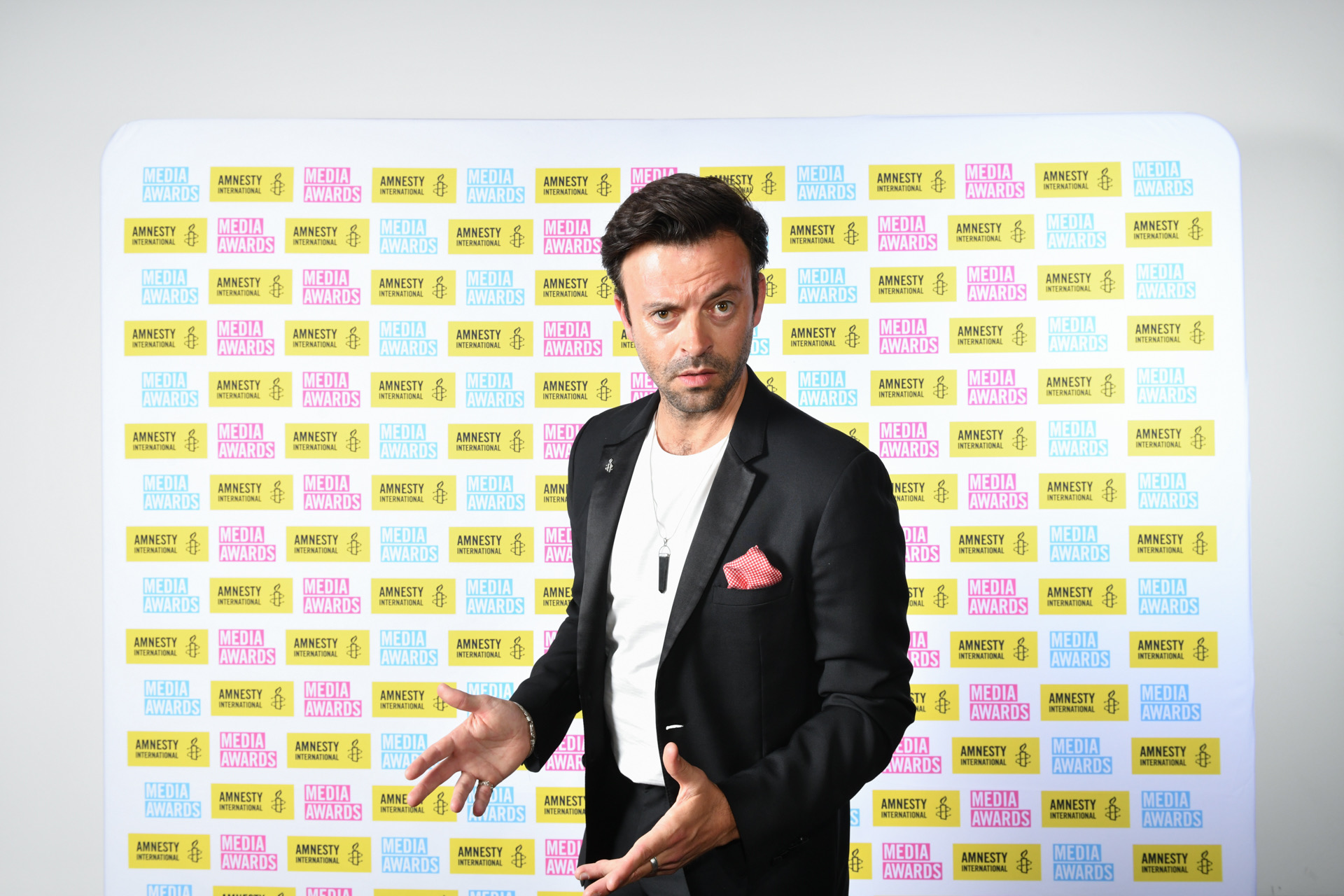
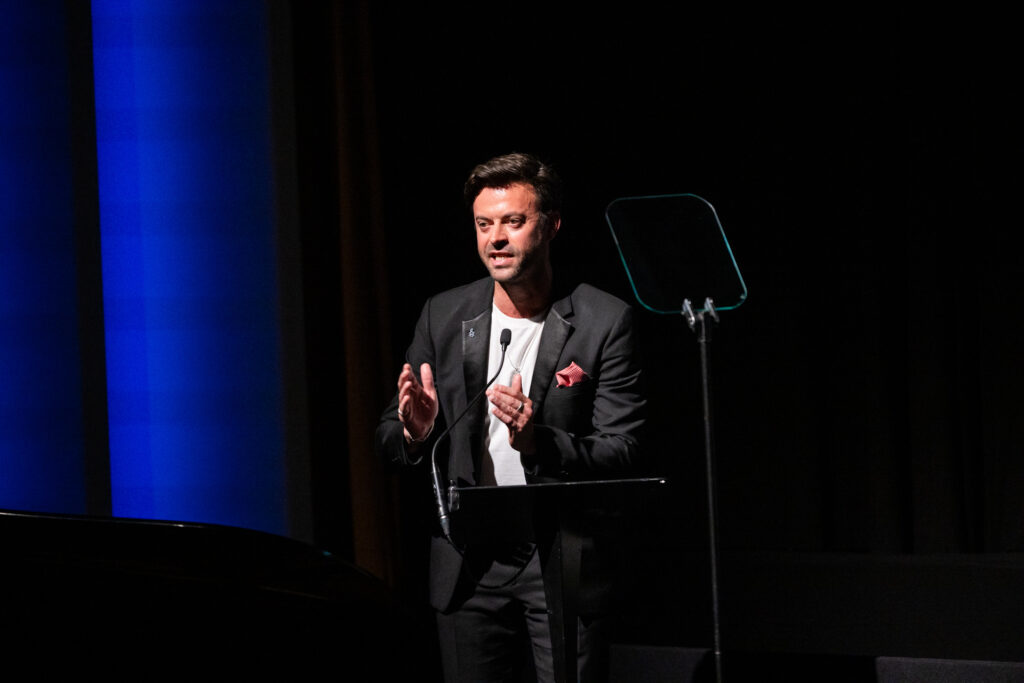
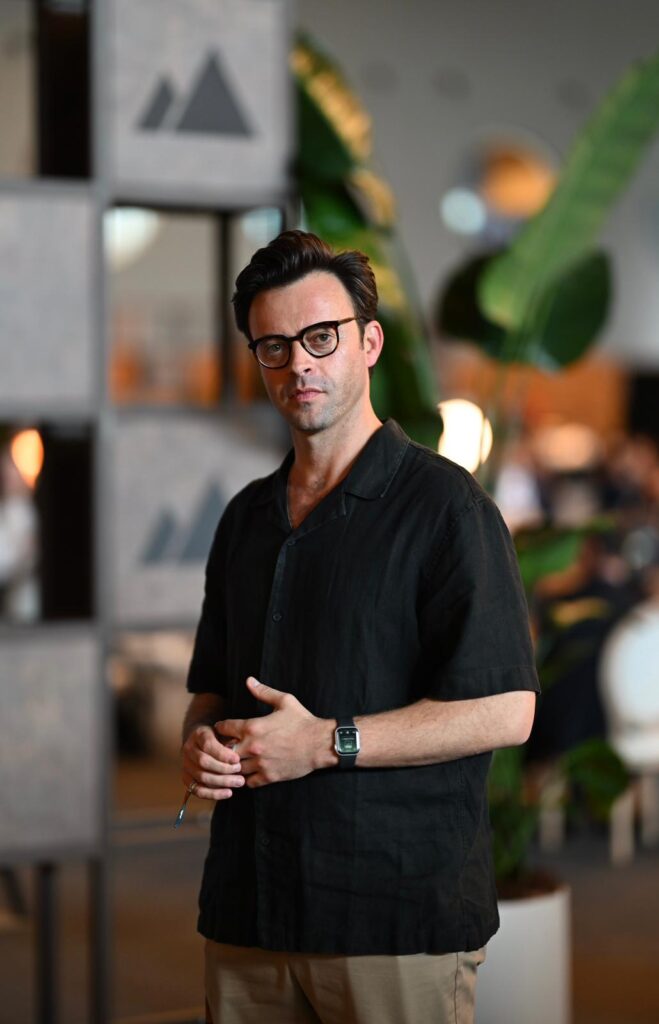
Feature Image Caption: Jolyon Rubinstein hosting the Amnesty International Media Awards 2025, at the BFI Southbank in London
Photo Credit: Lukas Schulze