The Capitalyst: Can you share your early memories of food and the kitchen and the moments that first sparked your love for cooking?
ViveQ Pawar: I come from a family of cops, which meant hot food was a rarity. My mother worked in airport security and travelled from Mumbai to Pune every single day. She would wake up around 2:45 or 3:00 a.m., cook three meals for seven to eight people, and then leave for work. So when I came back from school, the food at home was always at room temperature. At the same time, there was this beautiful aroma drifting in from our neighbour’s kitchen. That contrast made me realise something very early on, food has a scent, a presence. Even on my way back from school or while playing in parks, the smells from street carts would pull me in. One day, I asked my mother why our house never had that aroma. She smiled gently, hiding her exhaustion, and said, “If the aroma is what excites you, why don’t you create it yourself?” That moment is where my training really began. My interest was fuelled by validation. When I made tea for my father or mixed glasses of Rasna for guests, I could see pride in his eyes. That pride kept pushing me to cook more and more. My first professional training came from a street dosa cart in Mulund. The owner happily taught me when I told him I wanted to learn Bombay-style crisp dosas. I learned everything, from lighting a coal stove to seasoning a tawa, working there for a stipend of one preparation of my choice.
The Capitalyst: When did cooking shift from a passion to a profession for you, and what were the defining steps that led you into the culinary world?
ViveQ Pawar: Seeing my passion, my entire family supported the idea of me becoming a chef. But destiny had other plans. In Grade 11, driven by FOMO and following my friends, I chose to pursue CA. I am dyscalculic, so you can imagine the struggle. Still, I didn’t quit, because being with my friends mattered to me at that age. One evening, during one of my father’s drinking sessions, he bluntly told me I was being foolish not to follow my passion. He assured me not to feel guilty about the exorbitant CA tuition fees going to waste. His only condition was that I would have to fund my own culinary education. Without hesitation, my mother mortgaged her fixed deposit for it. From that moment on, my path was clear.
The Capitalyst: Your work reflects a deep respect for ingredients. When did sourcing and quality become central pillars of your cooking philosophy?
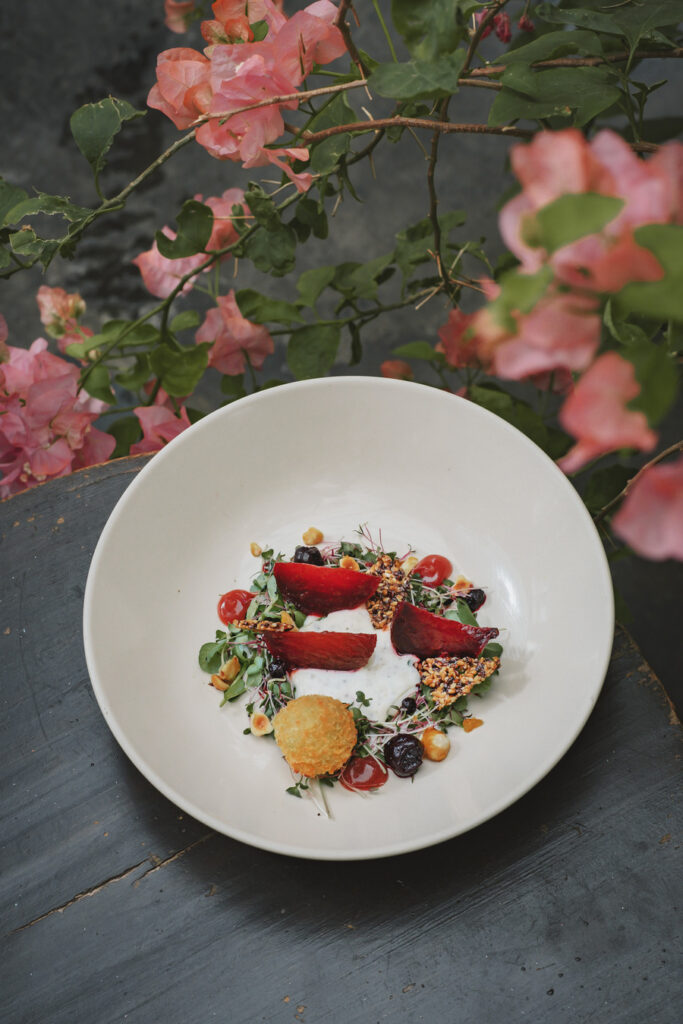
ViveQ Pawar: Growing up in India, like most people, I was introduced to cooking through Chef Sanjeev Kapoor. But my worldview shifted the day I encountered Chef Marco Pierre White. I remember my brother flipping channels when suddenly I saw a man bare-bodied, cigarette in his mouth, holding a shark like it was meant to be cooked by him. The more I watched Marco Pierre White and later Anthony Bourdain, I realised they spoke the same language. That Mother Nature is the true artist, and we are merely cooks. As cooks, we must be humble enough to recognise that. In India, unfortunately, there’s a strange belief that skill lies in taking poor produce and making it taste good with onion, garlic, fat and spice. I find that deeply sad. Cooking is about nourishment through art. It’s about treating ingredients with respect. A salsa in Mexico and a salsa in Bengaluru will taste different because the tomatoes are different. It really boils down to something that simple.
The Capitalyst: In your widely discussed explanation on pricing, you spoke about premium ingredients and honest food. How do you help diners understand the unseen work and costs behind what reaches their plate?
ViveQ Pawar: All I’ve really done is start a conversation. Many chefs carry a false air of superiority, a pride that comes from believing they know better than the guest. But they fail to see where the real problem lies. The problem is awareness. Dining in India has evolved rapidly. There was a time when eating out was a luxury, and international cuisines were available only in five-star hotels. Then came flagship restaurants like Olive and Indigo, led by Chef Saby and Chef Rahul Akerkar. Today, dining out is a part of daily lifestyle. Spending power has increased, but information hasn’t. And Indian diners, rightly so, don’t care about your accolades. They’re paying for their food. The only way forward is education through conversation. And conversation can only happen through humility. Knowledge is accepted only when it’s offered humbly.
The Capitalyst: Your Ancient Rome–inspired pasta menu in Bengaluru was immersive and transportive. How did you research this concept, and which dishes best capture that historical narrative?
ViveQ Pawar: Sadly, restaurants in India have lost the plot. Everything has become repetitive, biryani festivals, Asian festivals, brunches, and high teas. The same ideas recycled for decades. I’m deeply passionate about culture and cooking. This menu was about giving diners more than red sauce and white sauce. It was about letting them experience something deeper. Along with the co-owner of Roxie and our Director of Operations, Mr. Pravesh Pandey, we asked a simple question: why can’t people have better pastas? That’s when I put on my research hat and dove into Roman culinary history. I was fortunate to be supported by a dear friend and well-wisher, Mr. Murali Shankar, owner of Farmedible products pvt. ltd, who helped me source authentic ingredients directly from Rome.
The Capitalyst: How would you describe your culinary signature or speciality in a few words, and what personal values does it reflect?
ViveQ Pawar: I see myself as a non-conformist chef within the Indian diaspora. My cooking focuses on treating ingredients with respect and extracting their best possible flavour, while gently adapting them to the Indian palate. I believe there is no such thing as a fixed recipe. Cooking has always been circumstantial, and that’s what allowed it to evolve. Somewhere along the way, herd mentality slowed that evolution and much was lost in translation. My work is an attempt to reclaim that honesty.
The Capitalyst: Beyond being a chef, you are also an entrepreneur. What have been the most rewarding and most challenging aspects of building food ventures in a city like Bengaluru?
ViveQ Pawar: Bengaluru is a city that listens, but it also tests you relentlessly. The most rewarding aspect of building food ventures here has been the openness of its people. This is a city shaped by migration, tech, travel, and curiosity. Diners here are exposed, informed, and willing to try something new if they sense honesty behind it. When you introduce a concept rooted in culture and intention rather than trend-chasing, Bengaluru responds. At the same time, the city demands consistency at scale, which is where the real challenge lies. Running a food business is not just about cooking well once, it’s about cooking well every single day, across teams, shifts, vendors, and seasons. Sourcing becomes a moving target, costs fluctuate unpredictably, and talent retention is a constant struggle. The hardest part is holding your ground creatively while navigating operational realities without diluting your values.
Entrepreneurship has taught me that food is only one part of the equation. People management, systems, and resilience matter just as much. The reward comes when all these elements align and the guest experiences something meaningful without ever seeing the complexity behind it.
The Capitalyst: On particularly demanding days in the kitchen, what motivates you to keep going—guest reactions, creative curiosity, or something more personal?
ViveQ Pawar: On difficult days, what keeps me going isn’t applause or creative curiosity alone. Those things matter, but they’re temporary. What truly anchors me is memory, responsibility, and the cost of choosing this life. I think of my mother waking up before dawn every single day, cooking for an entire household before heading to work, and still telling me, with quiet certainty, that she knew her son would find his worth. I think of my father’s pride over the smallest things, a cup of tea, a simple plate of food. Those moments now feel heavier than any award or applause. My father breathed his last in Mumbai the very next day after the launch of the grandest restaurant of my career. A moment that was meant to be celebration turned instantly into grief. I remember standing between two worlds, one where everything I had worked for had finally taken shape, and another where I had just lost the man who believed in me before I believed in myself. Soon after, I lost that restaurant too. Success and loss arrived together, almost cruelly, as if to remind me how fragile both really are. There were sacrifices no one sees. I wasn’t present with my father the way I wanted to be when his health began failing. I was writing menus while he lay in a coma. I was building kitchens while learning how to live with the idea that he might never wake up. Those moments strip the romance out of this profession very quickly. I sacrificed friendships, personal time, and the luxury of slowing down. I never gave myself space to grieve a broken engagement. There was always another service to run, another responsibility waiting. During COVID, when everything shut down, I cooked tiffins for people just so they could eat. I worked for cash in restaurants to keep myself afloat. There was no pride in it, only survival. So when a service is brutal or exhaustion takes over, I remind myself that I am not just performing a role in a kitchen. I am carrying a story shaped by belief, loss, endurance, and faith placed in me by people who are no longer here to see what I’ve become. Cooking, for me, has never been an escape. It’s a commitment. To honour my parents, the sacrifices made for me, the ones I made myself, and the promise I carry quietly every day, to never let any of it go to waste.
The Capitalyst: Looking ahead, what ambitions do you hold as a chef? Are there new menus, concepts, or collaborations you are eager to explore?
ViveQ Pawar: Looking ahead, my ambition is not scale for the sake of scale, but depth. I want to keep creating menus rooted in history, culture, and lived experience rather than chasing passing trends. Food, for me, should transport, educate, and comfort all at once. I’m deeply interested in closer collaborations with farmers, foragers, cheesemakers, millers, and artisans, people who understand ingredients at their source, because I believe the future of meaningful cooking lies in shortening the distance between the land and the plate. Alongside this, I’m investing more time and energy into social media as a tool for engagement and education, not just visibility. I’m in the process of building an affordable online school model that showcases Indian produce, teaches how to cook with it respectfully, and encourages cooks to think beyond technique, to understand why a dish exists, where it comes from, and how it should evolve responsibly. Mentorship and knowledge-sharing are central to what I want to build next, because real growth in our industry comes from understanding, not imitation.
The Capitalyst: For young cooks inspired by your journey, what advice would you offer on balancing creativity, discipline, and respect for ingredients in a professional kitchen?
ViveQ Pawar: Please be honest to yourself. Why is it that you wanted to be a chef? Is it the idea of being a chef that excites you or it is the passion that fueled you to be one. Be honest, because it is okay if cooking is just a hobby for you it is completely fine. In today’s age there are multiple avenues one can step in. The second thing I would tell young cooks is this, discipline must come before creativity. It is the profession and not that the idea of being a chef without discipline, creativity becomes noise. Learn your basics thoroughly, understand repetition, respect timing, and show up every day willing to do the unglamorous work. Respect ingredients before you try to transform them. If you don’t understand an ingredient in its purest form, you have no business trying to innovate with it. Cooking is not about overpowering ingredients, it’s about listening to them. Finally, keep your ego in check. The kitchen is not a stage, it’s a place of service. Cook with humility, stay curious, and remember that food is never about showing off. It’s about nourishment, memory, and care. When you understand that, balance naturally follows.